
Unlocking Heart Health: The Power of Serrapeptase and Nattokinase
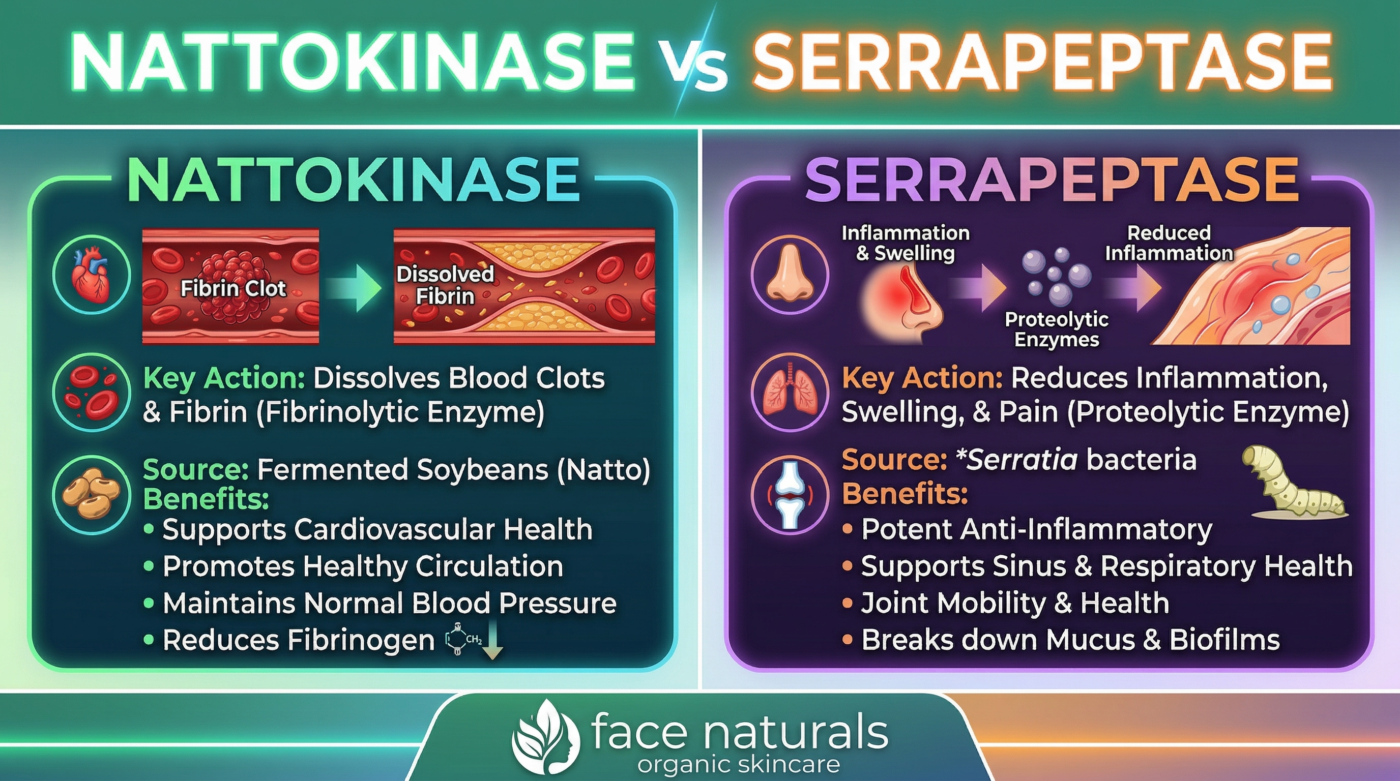
Cardiovascular Impact of Serrapeptase and Nattokinase
Cardiovascular disease remains a central focus of global medical research and clinical intervention. Established pharmacological therapies, including statins, antiplatelet agents, and anticoagulants, form the foundation of evidence-based treatment. These standard interventions have been rigorously tested and proven to reduce morbidity and mortality in high-risk populations.
At the same time, naturally derived proteolytic enzymes have attracted scientific interest as potential adjuncts due to their biochemical effects on inflammation and fibrin metabolism. Among these naturally occurring compounds, serrapeptase and nattokinase are two of the most widely discussed and researched.
Proteolytic enzymes function by breaking down proteins into smaller peptides or amino acids. In the context of cardiovascular physiology, their relevance stems primarily from their interactions with fibrin and inflammatory pathways.
Fibrin plays a central role in blood clot formation, an essential process for wound healing that can become pathological when it leads to thrombosis in the arteries or veins. Chronic inflammation contributes heavily to endothelial dysfunction and the progression of atherosclerosis. It is important to distinguish, however, that atherosclerotic plaques are composed mainly of lipids, immune cells, and fibrous connective tissue, rather than fibrin itself.
Nattokinase, derived from a traditional Japanese fermented soybean food known as natto, and serrapeptase, isolated from Serratia species associated with silkworm biology, exhibit distinct biochemical properties.
Understanding their potential clinical relevance requires a careful evaluation of both mechanistic data and human research. This analysis evaluates the current scientific literature, examining how these enzymes function and what the clinical data actually reveals regarding their cardiovascular efficacy.
Biochemical Profiles and Mechanisms of Action
To understand how these proteolytic enzymes might influence heart health, we must examine their fundamental mechanisms of action at a biological level.
Nattokinase
Nattokinase is a specific fibrinolytic enzyme produced by the bacterium Bacillus subtilis during the fermentation process of soybeans. It has been evaluated in laboratory settings and some human studies to determine its precise effects on the circulatory system. Research indicates that nattokinase can directly degrade fibrin in vitro.
Furthermore, nattokinase appears to enhance endogenous fibrinolytic activity, which includes an increase in the body’s natural plasmin activity. It also demonstrates the ability to influence various coagulation-related pathways.
Unlike traditional anticoagulant medications, which primarily inhibit the initial formation of a blood clot, nattokinase may actively contribute to fibrin breakdown through these multiple intersecting mechanisms. However, a critical gap remains in the scientific literature.
The extent to which these in vitro and early-stage effects translate into clinically meaningful reductions in thrombosis risk for human patients remains under active investigation.
Serrapeptase
Serrapeptase, also known scientifically as serratiopeptidase, is a proteolytic enzyme with established anti-inflammatory properties in certain specific clinical contexts. Laboratory and clinical observations have shown that serrapeptase can significantly reduce swelling and inflammatory exudates.
Serrapeptase is also known to modulate inflammatory mediators such as bradykinin, which plays a role in pain and vasodilation. Furthermore, it demonstrates the ability to degrade non-living protein substrates in controlled laboratory settings.
While these biological properties are highly relevant to tissue healing and localized inflammation, there is currently no clinical evidence demonstrating that serrapeptase reduces atherosclerotic plaque, prevents thrombosis, or improves cardiovascular outcomes in humans. Its potential role in cardiovascular health is therefore considered entirely indirect and investigational at this stage.
Key Scientific Studies on Nattokinase
The scientific community has conducted several studies to evaluate the efficacy and safety of nattokinase. The following studies represent key milestones in this ongoing research.
Study 1: Discovery of Fibrinolytic Activity (Sumi et al., 1987)
In a landmark study published in the journal Experientia, researchers officially identified nattokinase as a potent fibrinolytic enzyme derived from natto. The study demonstrated the complete dissolution of fibrin clots in vitro when exposed to the enzyme. Additionally, the researchers noted a distinct reduction of experimentally induced thrombi in animal models.
These early findings successfully established the biochemical basis for further clinical investigation. They proved that the enzyme was biologically active against blood clots in controlled environments, though they do not alone confirm clinical efficacy or safety in a human population.
Study 2: Atherosclerosis and Vascular Markers (Chen et al., 2022)
A more recent investigation published in Frontiers in Cardiovascular Medicine examined the effects of nattokinase in individuals diagnosed with hyperlipidemia and carotid atherosclerosis. The reported findings included measurable reductions in carotid intima-media thickness and various plaque measurements over the study period.
Interpretation of these results requires strict academic caution. The study design included potential confounding variables and has not yet been widely replicated in large, independent randomized controlled trials. As such, these findings should be considered preliminary rather than definitive evidence of plaque regression in humans.
Study 3: Blood Pressure Effects (Kim et al., 2008)
A rigorously designed randomized, double-blind, placebo-controlled trial published in Hypertension Research evaluated nattokinase supplementation in individuals with elevated blood pressure. Over an eight-week period, participants receiving the nattokinase supplement experienced modest but statistically significant reductions in both systolic and diastolic blood pressure compared to the placebo group.
While the exact physiological mechanism driving this blood pressure reduction is not fully established, this trial represents one of the more robust areas of human evidence supporting nattokinase’s potential relevance to cardiovascular management.
Key Scientific Studies on Serrapeptase
Research on serrapeptase has largely focused on its anti-inflammatory capabilities rather than direct cardiovascular interventions.
Study 1: Anti-inflammatory Effects (Mazzone et al., 1990)
A multicenter, double-blind, placebo-controlled trial demonstrated that serrapeptase significantly reduced tissue swelling and improved clinical symptoms in patients suffering from various inflammatory conditions. These findings strongly support its clinical use as an effective anti-inflammatory agent in specific medical contexts, particularly those involving trauma or localized fluid accumulation.
In cardiovascular terms, this property may be indirectly relevant. Chronic systemic inflammation is a known contributor to vascular disease and endothelial damage. However, this study did not assess any direct cardiovascular outcomes, meaning its application to heart health relies on theoretical extrapolation rather than direct proof.
Study 2: Preclinical Mechanistic Observations
Early experimental studies have clearly shown that serrapeptase can influence inflammatory mediators and break down certain protein substrates in vitro. While these findings provide excellent insight into the enzyme’s potential molecular mechanisms, they completely fail to establish clinical effects on arterial plaque or vascular structure in living organisms.
Importantly, commonly cited studies involving the reduction of mucus viscosity or the treatment of localized inflammation do not provide any evidence for arterial plaque removal or vascular “cleaning.” Such interpretations are biologically inaccurate and should be strictly avoided in clinical discussions.
Combined Use: Theoretical Considerations
The distinct biochemical profiles of nattokinase and serrapeptase have naturally led to significant clinical interest in their combined use. Conceptually, the pairing makes biological sense based on their individual mechanisms. Nattokinase may actively influence fibrin turnover and coagulation-related pathways, while serrapeptase may contribute to the overarching modulation of inflammatory processes.
Because both thrombosis and chronic inflammation play critical roles in the progression of cardiovascular disease, this combination is sometimes described by practitioners as complementary. However, it is critical to emphasize a major limitation in the current scientific literature: there are currently no clinical trials evaluating the combined use of nattokinase and serrapeptase for cardiovascular outcomes. Any claims of synergistic therapeutic benefit remain strictly hypothetical and lack empirical validation.
Frequently Asked Questions
Are these enzymes safe with blood thinners?
Both nattokinase and serrapeptase possess the ability to influence clotting processes and blood rheology. Combining these potent enzymes with prescription anticoagulant or antiplatelet medications, such as warfarin, clopidogrel, or aspirin, may significantly increase the risk of severe bleeding. Medical supervision is absolutely essential before combining these agents.
How are these enzymes absorbed?
As complex protein-based compounds, both serrapeptase and nattokinase are highly susceptible to rapid degradation by stomach acid in the gastrointestinal tract. Enteric-coated formulations are specifically designed to improve structural stability and ensure intact delivery to the alkaline environment of the intestines. However, definitive human data regarding their systemic absorption and total bioavailability remain highly limited in the current literature.
What are typical dosages?
Nattokinase is commonly dosed in fibrinolytic units (FU), with clinical research often utilizing a range of 2,000 to 4,000 FU per day. Serrapeptase is typically measured in serrapeptase units (SPU or SU), with commonly marketed therapeutic doses ranging from 40,000 to 120,000 units. It should be strongly noted that standardized clinical dosing guidelines for cardiovascular prevention have not been established by any major medical board.
Integrating Enzymes into Cardiovascular Research
Current scientific evidence undeniably supports the biological activity of both nattokinase and serrapeptase, particularly in relation to fibrin metabolism and the modulation of inflammation. Nattokinase has demonstrated modest, measurable effects in human studies, specifically concerning blood pressure reduction and potential vascular benefits. Serrapeptase has established itself as a capable anti-inflammatory agent in localized tissue studies.
However, neither enzyme has been proven in large-scale randomized controlled trials to prevent or successfully treat major cardiovascular events such as myocardial infarction or ischemic stroke. As a result, they cannot and should not be considered substitutes for established, evidence-based medical therapies.
At present, these proteolytic enzymes are best viewed as investigational or adjunctive compounds within the much broader context of cardiovascular research. Future well-designed, long-term clinical trials will be necessary to definitively clarify their therapeutic efficacy, systemic safety, and optimal role in evidence-based cardiovascular practice.
Sources
Sumi, H., et al. (1987). “A novel fibrinolytic enzyme (nattokinase) in natto.” Experientia.
Chen, H., et al. (2022). “Management of atherosclerosis and hyperlipidemia with nattokinase.” Frontiers in Cardiovascular Medicine.
Kim, J. Y., et al. (2008). “Effects of nattokinase on blood pressure.” Hypertension Research.
Mazzone, A., et al. (1990). “Evaluation of serratiopeptidase in inflammatory conditions.” Journal of International Medical Research.
